

What is a tanpura instrument?
A tanpura (also spelled tambura) is a fretless Indian plucked-string instrument that provides a continuous-sounding drone. Its usually four open strings are played in a slow cycle, keeping the singer's chosen tonic Sa audible. It accompanies melody rather than playing the melody itself.
Why musicians use a tanpura
A tanpura is deliberately simple in one respect: it does not follow the singer note by note. Instead, the overlapping strings keep the tonal centre present as a reference for every swara. This is useful in both Hindustani and Carnatic traditions, for vocal practice and many instrumental performances. The musician chooses the pitch of Sa; there is no universal concert pitch for every singer.
Unlike a sitar, the tanpura does not have frets to press for melodies. The strings are plucked open in a repeating order. A student may accompany a teacher by maintaining a steady, unobtrusive drone while the solo line moves around it. See Grinnell College’s instrument collection for a documented description of that role.
Parts of a tanpura, from pegs to resonator
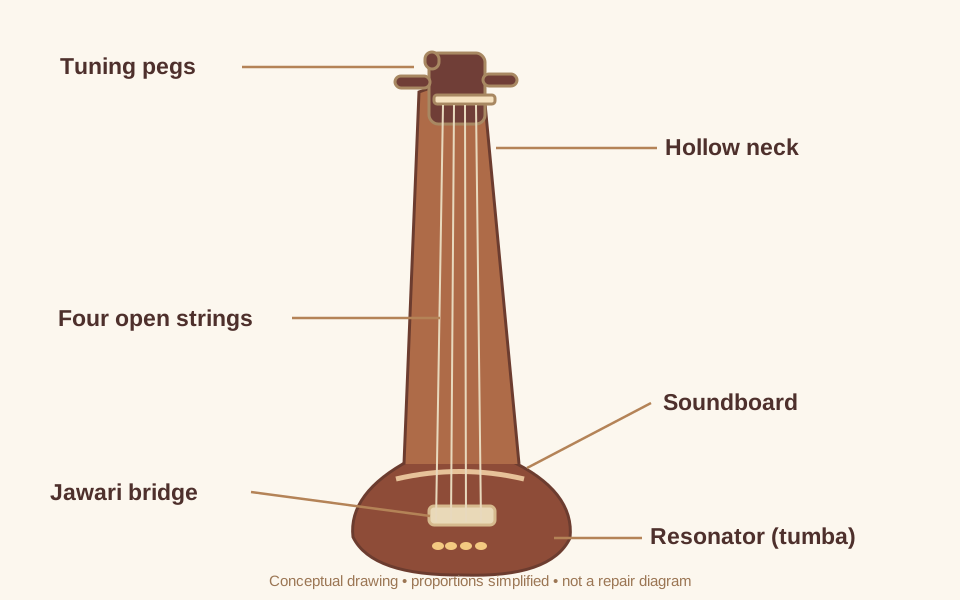
The pictured instrument is the familiar Miraj-style tanpura. Names and construction details vary by maker and region; for example, some sources write tabli and others tagli. The key is understanding each part's job rather than memorising one supposedly universal spelling.
| Part | What to notice | Why it matters |
|---|---|---|
| Tumba | Rounded gourd body | Resonating cavity that colours and projects the sound |
| Tabli / soundboard | Thin wooden face | Transfers bridge movement into the resonator |
| Dandi | Long, hollow, fretless neck | Supports the strings and contributes resonance |
| Gulu | Neck–body junction | Connects the resonator and neck |
| Khunti | Large tuning pegs | Change string tension for coarse tuning |
| Jawari bridge | Wide, gently curved contact surface | Helps generate a distinctive, changing overtone-rich buzz |
| Jiva thread | Thread set beneath each string at the bridge | Changes the contact relationship and character of the buzz |
| Mani / beads | Small beads near the string ends | Used for fine tuning on many instruments |
| Strings | Usually four wires of different gauges | Create Pa, the paired Sa notes and low Sa |
At the top, the khunti pegs adjust string tension. Along the hollow dandi, the strings travel over an upper guide and then down to the body. Their vibration is transmitted through the jawari bridge to the tabli and hollow tumba. The small mani beads assist with fine pitch adjustment, while the jiva threads are involved with the bridge contact that shapes timbre. Duke University and Grinnell College describe the construction in greater detail.
Why the tanpura sounds so rich: strings, jawari and resonance
The distinctive shimmery tone is more than a set of four musical notes. First, a gentle pluck starts a string vibrating. As it moves, the string interacts with the broad, curved contact region of the jawari bridge. That changing contact introduces a rich set of upper partials, or overtones. The body and soundboard then amplify and colour the result. As another string is plucked, the previous one is still ringing: the notes overlap rather than arriving as isolated beeps.
The small jiva thread beneath a string helps establish its contact with the bridge. It is an adjustment aid, not a magical component that makes every overtone by itself. A technical 2014 research paper by van Walstijn and Chatziioannou models the distributed bridge contact and changing overtone behaviour. For the player, the practical lesson is simpler: jawari is a balance of string, bridge and thread, and professional adjustment requires care.

The photo is especially useful because the jawari's surface is not a sharp point like the bridge of many Western string instruments. The vibrating string touches a wider region. A worn bridge, unsuitable string or shifted thread can change the sound even when a pitch tuner displays the correct note.
Tanpura strings and tuning: Pa–Sa–Sa–low Sa
Most beginners meet the four-string cycle Pa → Sa → Sa → low Sa, repeated smoothly. The first string is the fifth (Pa), the next two match the chosen Sa in unison, and the last, usually thickest string, is Sa an octave lower. Some traditions use Ma, Ni or other variations for the first string. Learn the physical tanpura tuning process in our separate practical guide.
| Pluck order | Role | Note | Approx. pitch |
|---|---|---|---|
| 1 | Pa | G2 | 98.00 Hz |
| 2 | Sa | C3 | 130.81 Hz |
| 3 | Sa | C3 | 130.81 Hz |
| 4 | Low Sa | C2 | 65.41 Hz |
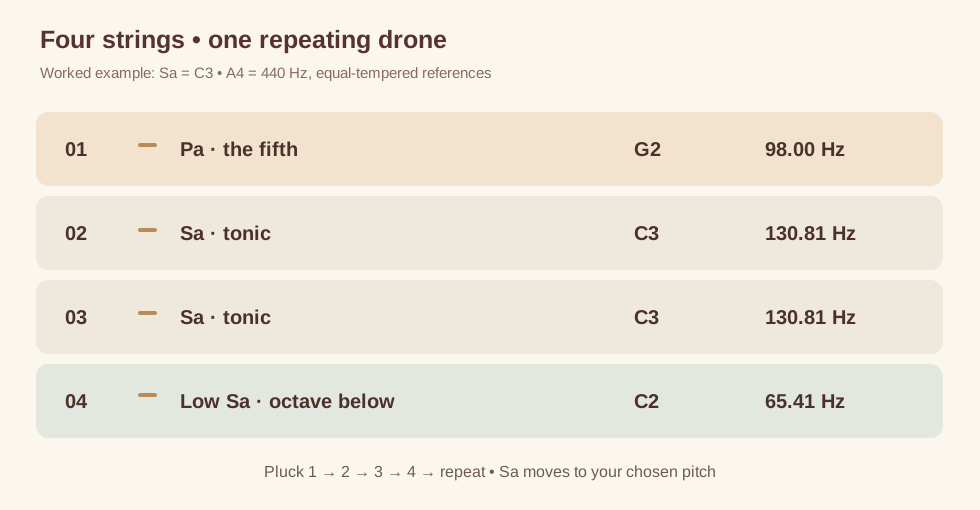
The frequency column is a reference, not an instruction to force every instrument to C. A pure fifth above C2 is approximately 98.11 Hz, slightly higher than the equal-tempered G2 value 98.00 Hz. That small difference illustrates why musicians use their ears to settle the final sound. Actual string choice and comfortable pitch range also depend on the instrument's construction.
Three common forms: Miraj, Tanjore and tanpuri
Miraj style
Familiar in Hindustani music. Often has a rounded dried-gourd resonator, a wooden soundboard, and a long, relatively straight neck. The making tradition is associated with Miraj, Maharashtra.
Tanjore / Tanjavur style
Associated with Carnatic music. Common examples use an all-wood body, sometimes carved from jackwood, with proportions, neck shape and decoration unlike the Miraj form.
Tanpuri / tamburi
A smaller, more portable drone instrument. The exact design and naming vary by region and maker; smaller does not automatically mean inferior.
Sizes traditionally labelled “male” and “female” in shops refer loosely to instrument scale and intended pitch range—not rules about which person may play which instrument. Choose by comfortable Sa and suitable string tension. The Metropolitan Museum of Art discusses instruments of these traditions with historical examples.
How a beginner holds and plays a tanpura
- Find a comfortable position. An instrument may be played upright with its resonator supported or, in some traditions, laid horizontally across the lap. Follow a teacher's safe handling advice and avoid straining your shoulder.
- Identify the four open strings. Locate Pa, the two matching Sa strings and low Sa before trying to keep a repeated cycle.
- Use a gentle fingertip motion. Let the string roll off the finger. Hard snaps make an uneven attack and can overpower a singer.
- Pluck in a consistent cycle. Move Pa → Sa → Sa → low Sa, allowing the sound of one string to overlap the next.
- Listen for balance. No string should jump out harshly; the tonic should remain easy to hear. A teacher can help with fingering and tempo conventions.
If the strings drift or the buzz seems uneven, use our step-by-step tanpura tuning guide. Bridge shaping, peg repair and other physical adjustments are specialist work; do not file or sand the bridge as a beginner.
Acoustic tanpura, electronic tanpura and shruti box
| Instrument | Sound source | What the listener hears |
|---|---|---|
| Acoustic tanpura | Open strings interacting with a curved bridge | Successive plucks with changing resonance and overtones |
| Electronic tanpura | Electronic generation or repeated recordings | A convenient, consistent repeating tanpura-like drone |
| Traditional shruti box | Air-driven reeds | More continuous sustained notes, not a plucked string cycle |
Tanpura.online is not a reed-style shruti box. Its electronic setting uses recordings from a Raagini electronic tanpura machine; its acoustic setting uses real tanpura recordings, both attributed to Sankalp Gulati. We process and transpose those recordings for practice. See the recording sources and licences for the exact provenance.
Try the sound: a three-minute listening exercise
You can start without owning a physical instrument. Open the free Tanpura.online player; treat it as an audible drone reference, not a microphone tuner or swara keyboard.
Hum a comfortable note. Use the twelve-note selector and octave setting to find a Sa that fits your voice. Avoid strain.
Select Acoustic, leave the first string on Pa and start playback at a comfortable volume. Hear how the sounds overlap.
Sing a relaxed “aa” on Sa, pause, listen to the drone, then repeat. Focus on steadiness rather than volume.
Switch to the Electronic recording. If your music calls for Ma, compare Pa and Ma, keeping your chosen Sa unchanged.
Changing the player’s Sa transposes a recording and can also change its pace and timbre. It does not analyse your voice, play all individual swaras or offer independent plucking-speed control.
Frequently asked questions
How many strings does a tanpura have?
Four is typical in many classical settings. Five-string and other forms exist. The standard beginner cycle here is Pa–Sa–Sa–low Sa.
Does a tanpura play a melody?
No. It supports a singer or instrumentalist with a drone; its strings are plucked open rather than fretted into changing melody notes.
Why does a tanpura buzz?
The string's interaction with the broad curved jawari bridge generates changing upper partials. String motion, bridge shape and jiva thread position work together.
Is Sa always C?
No. Sa is chosen for the singer or instrument; C3 was just our numerical example.
Is a tanpura the same as a shruti box?
No. A traditional shruti box produces sustained reed sounds; an acoustic tanpura produces overlapping plucked strings.
Can an electronic tanpura replace a physical one?
It can provide a convenient daily reference, but it does not reproduce the full acoustic interaction of a physical instrument and a room.
Sources and image credits
This explainer draws on published instrument collections, a documented bridge-acoustics study and specialist instrument guides. Some terminology and performance conventions vary by school or maker.
- Grinnell College · Tambura instrument collection — parts, playing, tuning, context.
- Duke University · Tambura (Maharashtra) — regional construction terminology.
- Van Walstijn & Chatziioannou (2014) — string–bridge contact and overtones.
- Toss Levy · Tanpura reference — practice and instrument care.
- The Metropolitan Museum of Art · Indian musical instruments — historical instrument examples.
- Original photographs by Martin Spaink and Martin Spaink, each CC BY-SA 3.0; displayed unaltered.