
How do you tune a tanpura?
For a common four-string tanpura, tune the strings in plucking order to Pa – Sa – Sa – low Sa. Choose a comfortable tonic (Sa) first, make the two middle strings match it, tune the thickest string one octave lower, and set the first string to Pa or another musically appropriate note. Finish by listening, not only by watching a tuner needle.
Before you tune: choose a comfortable Sa
Sa is movable. Indian classical singers do not all tune their tonic to one fixed Western note. A label such as C3, D3 or G3 is a convenient reference for a particular singer and instrument. Start by humming an easy note, checking that you can sing a little higher and lower without effort, and confirming it on a harmonium, keyboard or trusted reference. Record that note for the session.
Then check that your physical instrument is designed to reach the chosen pitch without excessive string tension. Larger and smaller tanpuras have different comfortable ranges, irrespective of who owns them. Never pull a string much tighter simply to make an arbitrary chart match.
You can hear an adjustable Sa through the Tanpura.online practice player. This is a recorded drone, not a microphone tuner or a physical instrument inspection tool.
Four tanpura strings and their tuning notes
The key to avoiding confusion is to number strings by the order in which they are plucked, not from a photo's left or right edge. Here, string 1 is Pa, strings 2 and 3 are middle Sa in unison, and string 4 is the thick low Sa (kharaj).
| String | Indian note | Reference | Approx. Hz |
|---|---|---|---|
| 1 | Pa | G2 | 98.00 |
| 2 | Sa | C3 | 130.81 |
| 3 | Sa | C3 | 130.81 |
| 4 | Low Sa | C2 | 65.41 |
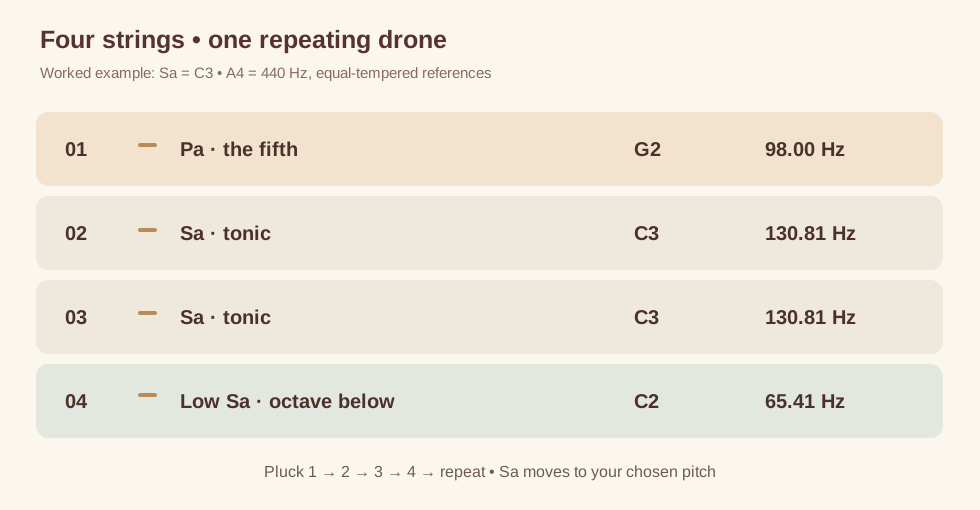
G2 at 98.00 Hz is an equal-tempered reference. A mathematically pure fifth above C2 is approximately 98.11 Hz, about 2 cents higher. That difference is small; musicians may refine the relationship by ear. Note also that some electronic keyboards label “middle C” differently: use frequency or a consistent octave system, not just the letter and digit.
How to tune a physical tanpura: a safe nine-step sequence
Instrument maker Toss Levy recommends tuning in the position in which the instrument is played, because moving it can alter pitch slightly. A teacher may prefer a supported horizontal position for coarse adjustments; whichever approach you use, always recheck in playing position.
- Inspect before adjusting. Look for loose beads, obvious string damage, a shifted bridge or a slipping peg. If a part is visibly damaged, get experienced help rather than forcing it.
- Set an external Sa. Use your teacher's note, a harmonium, keyboard or a reliable reference recording. Sing the note to be sure the pitch is comfortable.
- Find strings 2 and 3. These are the matching middle-Sa strings. Pluck each gently and identify the current pitch rather than assuming its octave.
- Coarse tune in small moves. Use a peg carefully to bring string 2 near Sa. Do not force a jammed peg or tighten into an obviously uncomfortable range for the string.
- Match the unison pair. Tune string 3 to string 2. Alternating or gently comparing them can reveal a slow wavering or beating if the pitches differ.
- Set low Sa. Tune the thick fourth string one octave below the paired Sa notes. If a digital tuner identifies a higher harmonic instead, verify the low note with your ear or another instrument.
- Choose the first string. Usually tune it to Pa (below middle Sa); certain musical traditions use Ma or Ni instead. See the comparison below before changing it for a raga.
- Fine tune and listen. Where the instrument is equipped for it, fine-tuning beads may make small pitch corrections. Their direction and handling vary; learn the method for your particular instrument from a teacher or maker. Do not try unsupervised bridge shaping.
- Play and recheck. Repeat the four-note cycle softly. Let the instrument settle, then verify both Sa strings remain stable and the overall drone sounds balanced.

Pitch and jawari are different jobs. Matching the four pitches does not automatically produce a good buzz, because the bridge surface, thread and string condition also matter. Avoid DIY filing, sanding, re-seating a bridge or forcing pegs. Such adjustments can permanently damage the sound. Specialist repairs deserve specialist help.

How to tell by ear when two Sa strings agree
Start with string 2 against your chosen Sa reference. When it is close, compare string 3 with string 2. A slow “wah-wah” pulse can indicate slightly different frequencies—an audible beating effect. As the pitches approach one another, the pulse often slows. The test is easier with soft, even plucks and without trying to follow the louder, unstable buzzing harmonics.
When the two Sa strings sound settled together, compare the low Sa in the octave below. Then play Pa against low Sa; as a fifth it should belong comfortably in the same sonic space. Do not chase every shimmer. Jawari changes overtones even on a well-tuned instrument. A small visual change in a phone tuner is not always a reason to turn a peg.
Pa vs Ma tanpura tuning—and when Ni appears
| First string | Relation to Sa | If Sa = C3 | Beginner guidance |
|---|---|---|---|
| Pa | Fifth above low Sa | G2 · 98.00 Hz* | Familiar default in many contexts |
| Ma | Fourth above low Sa | F2 · 87.31 Hz* | Used in some Pa-avoiding contexts |
| Ni | Seventh above low Sa | B2 · 123.47 Hz* | Advanced variation; follow your tradition |
*Equal-tempered reference values; a physical tanpura is refined by ear.
Pa is a starting point, not a universal law. For raga Malkauns, several teaching sources describe Ma tuning because the raga omits Pa. However, traditions differ. Some musicians continue using Pa even for certain ragas that do not feature it, while the choice of Ni in ragas such as Marwa has varied by teacher and school. See Toss Levy’s tuning variations and Sangat’s comparative examples for contrasting approaches.
For your own repertoire, a teacher's practice takes precedence over a generic raga table. The Tanpura.online player offers Pa and Ma based on available recordings; it does not provide a genuine Ni sound source.
Troubleshooting: why your tanpura will not stay in tune
| Symptom | Possible cause | Safe next check |
|---|---|---|
| One string drifts quickly | New string settling, loose peg or sliding bead | Retune carefully over time; request help if it jumps suddenly |
| Sa pair produces pulses | The two middle strings are not quite in unison | Compare them softly, one at a time, with the same Sa reference |
| Lowest string seems too high | Wrong octave or tuner reading a harmonic | Compare against a note exactly one octave below Sa |
| Peg slips or jams | Peg fit, wear or environmental changes | Stop if it resists; consult a teacher or instrument technician |
| Buzz changes despite correct pitch | Jiva placement, jawari wear or string condition | Check with a teacher/maker; do not file the bridge yourself |
| Drone sounds harsh | Hard plucking or uneven string balance | Pluck more gently, then compare the four strings in a slow cycle |
| New string takes time to settle | Normal initial stretching | Make small corrections at several sessions; seek help if it never stabilises |
A five-minute listening exercise with an online drone
This exercise trains your ear; it does not mechanically tune a real tanpura.
Choose a comfortable Sa in the free tanpura player, leave Pa selected and lower the volume.
Listen for Pa, middle Sa twice, and the lower Sa. The tones overlap rather than stopping after every pluck.
Hum a quiet steady Sa, rest, then repeat. Listen for obvious wavers between your voice and the reference.
Try singing Sa softly in a lower register if comfortable. Do not force a note beyond your easy range.
Switch first-string selection to Ma and listen to what changes while Sa stays selected. Return to Pa for a familiar ending.
Our player uses licensed recorded material. Transposing it may alter both pitch and the recording’s natural plucking speed and timbre. It cannot hear your physical strings or tell you whether they are correctly tuned.
Frequently asked questions
Can I tune a tanpura with a phone tuner?
A tuner can help locate a pitch and octave, but a buzzing, overtone-rich string can confuse pitch detection. Finish by ear, and ask a teacher if uncertain.
Are the middle two strings the same Sa?
In a standard four-string Pa-based setup, yes. They are tuned in unison and are the centre of the drone.
What if the first string is Ma instead of Pa?
That is a legitimate choice in some musical traditions. Confirm the raga and your teacher's convention before switching.
How often should I retune?
Check before practice and after moving the instrument, large temperature changes or installing a new string.
Does the digital player tune a physical tanpura?
No. Tanpura.online supplies an audible recording but has no microphone pitch detector or individual-string tuning controls.
Can I repair a slipping peg myself?
Do not force a jammed peg or apply unverified materials to the instrument. A qualified technician or teacher can identify a safe fix.
References, care notes and photo credit
- Toss Levy · Tuning process and common problems — stability, parts and tuning position.
- Toss Levy · Tuning variations — Pa, Ma and other conventions.
- Grinnell College · Tambura — string and hardware reference.
- Sangat · Pa, Ma or Ni? — alternative raga practices.
- Toss Levy · Instrument maintenance videos — expert demonstration collection (external); watch before attempting physical work.
- Bridge photograph: Martin Spaink, CC BY-SA 3.0; unaltered photograph.
This is general educational guidance, not a substitute for hands-on instruction on a fragile stringed instrument. Raga conventions differ; consult your teacher for repertoire-specific choices.