

What does Shruti mean in music?
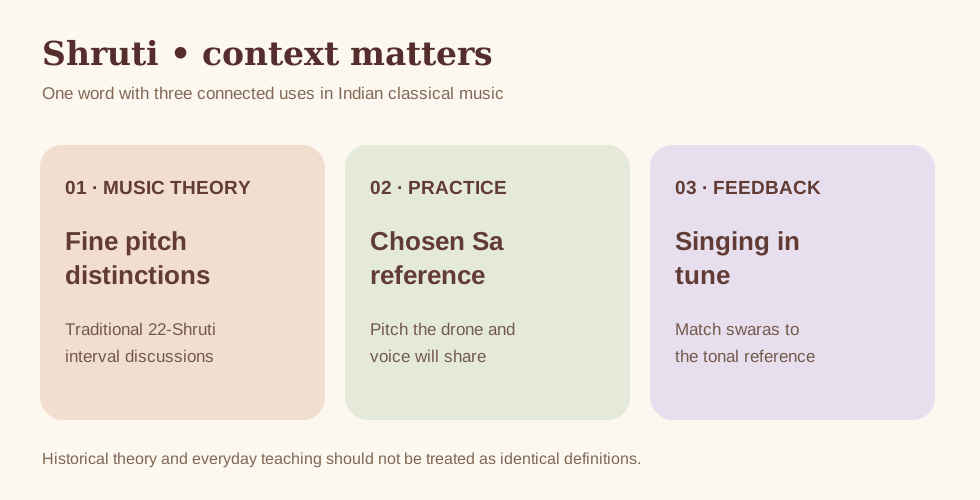
Shruti (also spelled Sruti or Shruthi) has related but different meanings. In classical theory it concerns fine pitch distinctions, traditionally discussed as 22 shrutis. In everyday Carnatic teaching, “my shruti” can mean the singer's chosen reference pitch, or Sa. To sing “in shruti” means to stay in tune with that reference.
Three useful meanings of Shruti
The same word appears in a music history discussion, a lesson with a tanpura, and a teacher's feedback on a student's singing. Those speakers may be talking about different aspects of pitch. Instead of treating one dictionary sentence as the only correct answer, begin with the situation in which the word is being used.
Fine pitch distinctions
Traditional texts discuss shruti as a unit or distinction associated with intervals and swaras. The classical framework describes twenty-two in an octave, but how those are measured and interpreted is debated.
Your reference Sa
In a Carnatic lesson, “choose your shruti” may simply mean selecting a comfortable tonic pitch to which the drone, voice and other instruments are aligned.
Being in tune
A teacher who says “sing in shruti” can mean that your swaras should stay accurately related to the chosen tonic, rather than drifting sharp or flat.
The practical and “in tune” usages appear explicitly in the Karnatik Carnatic glossary. The theoretical discussion is documented in the classic 1963 intonation study by Jairazbhoy and Stone, which notes the different historical and modern interpretations.
Shruti vs Swara: what is the difference?
Swara refers to a named musical note or degree such as Sa, Re/Ri or Ga. Those names describe the note's role in the music. Shruti, when used in its theoretical sense, concerns finer distinctions of pitch or intervals within a musical system. When used in a Carnatic lesson, it may mean the chosen reference pitch relative to which all swaras are sung.
| Question | Swara | Shruti |
|---|---|---|
| What does it name? | A musical note or role, such as Sa or Ga | A pitch distinction in theory; or the reference pitch in practical teaching |
| Can Sa move? | Yes, the performer chooses the actual pitch of the tonic Sa | The session's reference shruti moves with that chosen pitch |
| What might a teacher say? | “Sing Ga and come back to Sa” | “Keep your voice in shruti with the drone” |
| Does it mean 22 equal keys? | No | No; the historical system has multiple scholarly interpretations |
For example, in an exercise in which Sa is C, Ga has a particular relationship to that Sa. If the same exercise is moved so that Sa is D, Ga moves too. That is the movable tonic idea. It does not mean that the musical term “Ga” equals one permanent Western frequency.
Our Sapta Swaras lesson covers the seven main note names and the twelve familiar introductory positions. This article focuses on the subtler word shruti, not on reteaching the entire seven-note system.
Why does Indian music theory describe 22 Shrutis?
Historical Sanskrit music theory discusses seven swaras and twenty-two shrutis in the octave. The Natyashastra-associated Shadja grama is commonly described with the interval-count allocation 4–3–2–4–4–3–2 across Sa, Re, Ga, Ma, Pa, Dha and Ni. These figures are an account of interval distances or allocations in a historical theoretical system; they are not an instruction to sing four different tonic Sa notes in one ordinary sargam exercise.
| Swara | Traditional allocation |
|---|---|
| Sa (Shadja) | 4 |
| Re / Ri (Rishabha) | 3 |
| Ga (Gandhara) | 2 |
| Ma (Madhyama) | 4 |
| Pa (Panchama) | 4 |
| Dha / Da (Dhaivata) | 3 |
| Ni (Nishada) | 2 |
| Total | 22 |
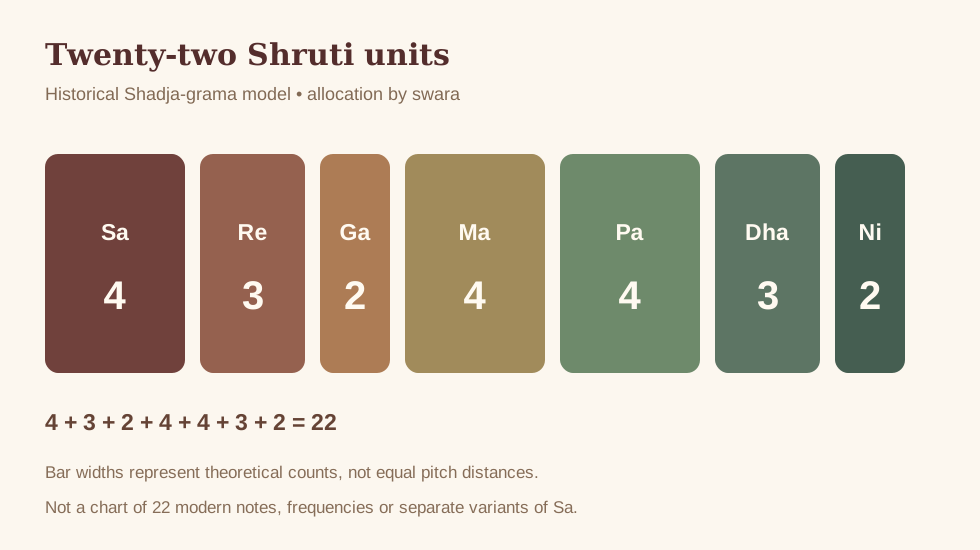

The count appears in classic musicological treatments, including The Music Academy Madras historical study and modern teaching summaries such as Artium Academy. The careful interpretation matters: allocations are not the same as saying every Sa has four modern independent frequencies or that each small interval is exactly one twenty-second of an octave.
Classical texts discuss more than one grama and several musical theories developed across centuries. Therefore, the 4–3–2–4–4–3–2 chart is one named historical arrangement, not a universal map of how every present-day Carnatic and Hindustani performer intonates every raga.
Are the 22 Shrutis equally spaced? What do musicians sing today?
No single equal-spaced set of twenty-two keyboard notes can be assumed to describe all Indian classical music. Historically, scholars have debated shruti as perceivable distinctions, interval units and individual musical pitch placements. Present-day researchers also disagree on how tightly particular performances can be fitted to any one historical scheme.
In their published analysis of North Indian intonation, Nazir Ali Jairazbhoy and A. W. Stone examined relationships between theoretical systems and observed pitch in performance. Their discussion shows why one fixed list of twenty-two precise frequencies would overstate the evidence. On the other hand, some modern scholars propose particular reconstructions or mathematical models of the historical theory. Those proposals need attribution and should not be taught as universally accepted facts.
Fine intonation matters when a musician approaches a swara from above or below, ornaments a note or settles into a raga phrase. Terms such as meend (a connected glide), andolan (a controlled oscillatory movement) and gamaka (a broad family of ornamentations) can help explain expressive pitch movement. Do not reduce these ornaments to one universal pitch offset measured in cents: their function depends on tradition, repertoire and phrase.
Students generally do not need to “perform all 22 shrutis one after another” before learning to sing. Listening steadily to a tonic and receiving feedback from a knowledgeable teacher is a more sensible beginning.
Shruti in Hindustani and Carnatic practice
In Carnatic music, it is especially common to speak of the performance's “shruti” as the selected pitch of Sa. The tanpura or a shruti box can support that reference. A teacher may ask a student to sing in shruti during early Sarali Varisai practice. Such everyday speech concerns pitch alignment, not a calculation of twenty-two microtonal notes. The Karnatik glossary documents both the reference-pitch and “in tune” senses.
In Hindustani music, shruti often appears in discussions of fine note placement, classical music theory and expressive raga intonation. Yet it would be inaccurate to insist that each tradition owns exactly one meaning: both involve a movable Sa, attentive listening, and relative pitch relationships. The importance or technical usage of the word can vary among musicians.
A vocalist may say their reference is C♯ in a Western-pitch notation and still use the name Sa for that tonic. A different singer may select G; the sargam syllables remain Sa Re Ga Ma Pa Dha Ni. This practical flexibility is fundamental to understanding the relationship between shruti and swara.
How a tanpura helps you hear Shruti
A tanpura provides overlapping drone tones that keep your selected Sa audible. On a physical instrument these are plucked strings; our online version plays attributed acoustic tanpura recordings or recordings from a Raagini electronic tanpura machine. When you sustain your own Sa, the drone is a steady sound to compare it against, but it does not tell you whether your note is perfect or how many cents you are off.
Open the free Tanpura.online player to hear that reference. Choose a comfortable tonic and octave, leave the first string on Pa for ordinary introductory listening, lower the volume and begin the drone. If you feel strain, change your own singing range or Sa choice rather than pushing the voice.
Two limits are important. First, this player does not reproduce twenty-two independently selectable shrutis, and it has no microphone pitch analysis. Second, changing its Sa transposes recorded audio and can alter the natural plucking pace and timbre as well as pitch. This is an audible listening aid, not a measurement instrument.
Is Shruti the same as a Shruti Box?
No. Shruti is a musical term with the meanings explained above. A traditional shruti box is a separate small drone instrument with air-driven reeds, producing more sustained tones than the repeated plucks of an acoustic tanpura. Electronic practice products also sometimes use “shruti box” loosely to mean a pitched drone machine.
Tanpura.online currently offers genuine recordings of acoustic tanpuras and of an electronic tanpura machine. It does not currently contain a separate reed-style shruti-box sound. The audio sources and licence page explains the actual recordings used.
Four-minute listening exercise: find and hold your Sa
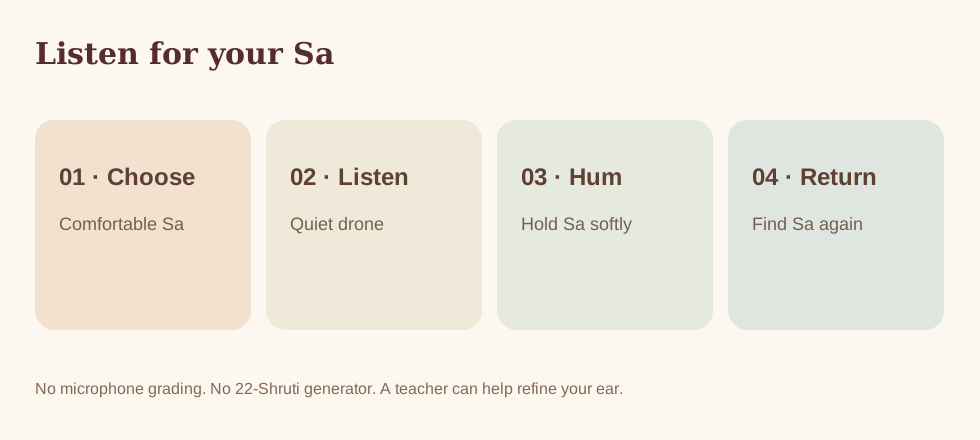
This short exercise develops awareness of your reference pitch without claiming to teach precise historical microtonal intervals. You do not need a microphone, a pitch app or a singing assessment. You need a comfortable note, a quiet drone and a little patience.
Select Sa and an easy octave on the tanpura player, choose Pa, and play the drone softly without singing. Hear the resting reference in the repeating sound.
Hum a short gentle note. Pause, listen to the drone again and repeat. Avoid strain or unusually long breath holds.
Move your voice slightly away from Sa and come back gently. Listen for whether the returning note seems steadier against the reference. A teacher can help judge it.
Try another comfortable Sa setting if desired, and notice that your reference pitch changes while the musical name Sa stays the same.
Five Shruti misconceptions to avoid
- “Shruti only means one thing.” Historical theory and practical Carnatic teaching use the word in related but different senses.
- “Twenty-two shrutis are twenty-two identical piano steps.” The historical system is not simply an equal division of an octave.
- “Each modern raga has one agreed table of fixed 22 frequencies.” Performance and theoretical interpretations vary.
- “Shruti and Swara are interchangeable.” A swara is a named note; shruti has other pitch-related meanings.
- “A tanpura automatically corrects your voice.” It supplies a reference. A singer still needs careful listening, practice and teaching feedback.
Frequently asked questions
What is Shruti in Indian classical music?
It is used for subtle pitch distinctions in music theory and, in everyday Carnatic practice, for the selected tonal reference (Sa) or being correctly aligned with it.
Are there really 22 Shrutis?
Twenty-two is the celebrated count in historical Indian music theory. How that system relates to measured intervals and modern performance is an active matter of interpretation, rather than one simple set of fixed notes.
How are 22 Shrutis distributed?
A widely cited Shadja-grama allocation is 4–3–2–4–4–3–2 across Sa, Re, Ga, Ma, Pa, Dha and Ni. The counts are not a list of four distinct everyday Sa pitches.
What is the difference between Shruti and Swara?
Swara names a principal note, such as Sa or Ga. Shruti can describe fine pitch distinctions or a performance's reference pitch, depending on context.
What does “sing in Shruti” mean?
In common Carnatic teaching, it usually means singing in tune with the selected Sa reference, normally supported by a tanpura or shruti box.
Is Shruti the same as a Shruti Box?
No. Shruti is a music term; a traditional shruti box is an air-driven reed instrument supplying sustained reference notes.
Can Tanpura.online play all 22 Shrutis?
No. It offers recorded tanpura drones with selectable tonic settings, Pa/Ma and basic tuning controls. It is not a 22-shruti note generator or microphone-based measuring device.
References and further reading
- Jairazbhoy & Stone · Intonation in Present-day North Indian Classical Music (1963) — academic analysis of ancient theory and present-day practice; article abstract and accessible notes reviewed.
- Karnatik · Glossary of Carnatic Music — practical meanings of shruti as a selected pitch and being in tune.
- Music Academy Madras · The Twenty-Two Srutis of the Indian Gamut (1930) — historical treatment of the count and allocations (reference for further checking).
- Artium Academy · What Is Shruthi in Music? — modern Carnatic-oriented teaching description; its historical interpretations are not treated as universal fact.
- SangeetCentral · Tanpura — example of drone-based pitch listening and physical instrument.
- Hero photograph: Karen Blaha · CC BY-SA 2.0, via Wikimedia Commons. The photo may be responsively cropped in the site layout; view original.
- Photograph of a specially described 22-shruti tanpura: Rupakpk · CC BY-SA 4.0, Wikimedia Commons; displayed at a smaller size.
Scholars and teaching traditions disagree on some historical details and practical pitch systems. This introduction deliberately avoids precise frequencies for the twenty-two theoretical shrutis. Musician review is still valuable for specialist raga claims.