

What are Sapta Swaras?
Sapta Swaras means the seven named notes of Indian classical music: Sa, Re (Ri), Ga, Ma, Pa, Dha (Da) and Ni. The sung syllables are used for sargam, and a run from one Sa to the next is a saptak. Sa is a movable tonic, not a pitch permanently fixed at C.
The seven swaras: names and meanings
These seven name families are shared across Indian classical traditions. They appear in slightly different Roman spellings, because Sanskrit terms are represented through regional languages. Hindustani learners commonly say Re and Dha; Carnatic materials often say Ri and Da. The important musical idea is the name's function relative to the chosen tonic.
| Short name | Sanskrit name | Learning note |
|---|---|---|
| Sa | Shadja | The tonic: your home note |
| Re / Ri | Rishabha | Second named swara |
| Ga | Gandhara | Third named swara |
| Ma | Madhyama | Fourth named swara |
| Pa | Panchama | The fifth: an important drone reference |
| Dha / Da | Dhaivata | Sixth named swara |
| Ni | Nishada | Seventh, leading towards upper Sa |
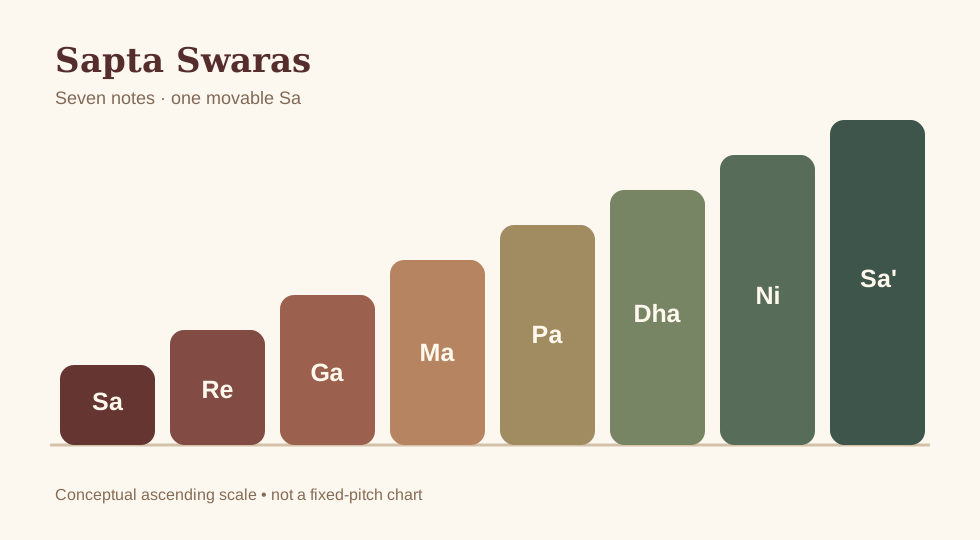
Some names appear without their final Sanskrit syllable—for example, Shadaj for Shadja or Pancham for Panchama. Your teacher's notation and pronunciation may vary. Learn one clear scheme before comparing alternative spellings.
Why Sa is the reference, not a fixed piano note
Sa is the pitch around which the other swaras are heard. If your voice is comfortable with C as Sa, you may use C. If another singer takes D, the same swara names move with that D. Their roles remain the same: Re stays the second, Ma the fourth and Pa the fifth relative to Sa.
Books may call Sa and Pa achal or “immovable” swaras. This does not contradict a movable tonic. In the elementary Hindustani classification, achal means Sa and Pa do not have komal or tivra versions relative to the chosen Sa. It does not prescribe one universal concert pitch.
The tanpura gives singers an audible background for Sa and normally Pa. Its strings are not a melody keyboard; the singer supplies the swaras. For the physical sound, see our Tanpura Instrument overview.
Seven swaras and twelve note positions—both numbers make sense
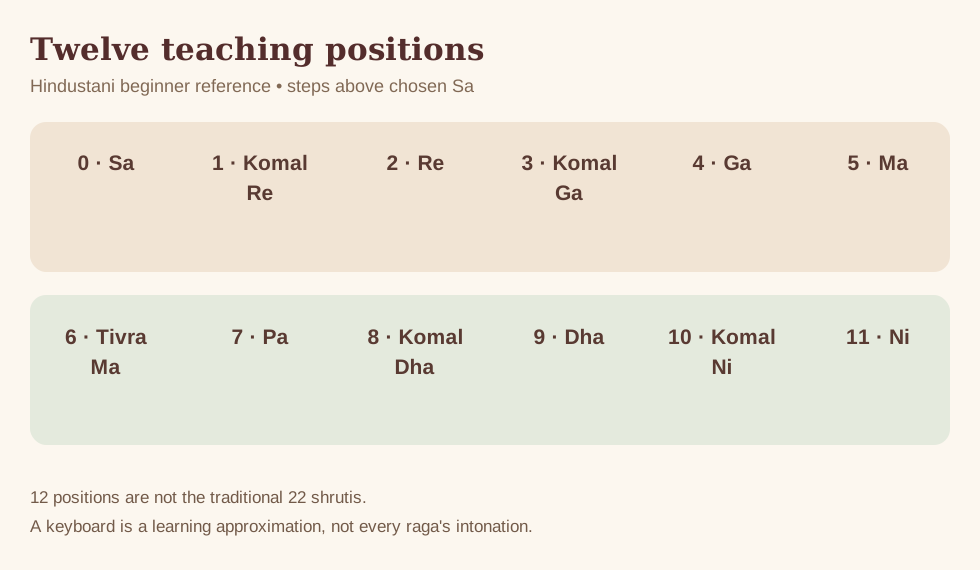
Seven is the count of basic names. In introductory Hindustani music theory, four names—Re, Ga, Dha and Ni—each have a lower or komal form. Ma has an upper or tivra form. Including the seven shuddha forms gives the twelve familiar pitch positions of an octave. Sa and Pa have no komal or tivra form in this beginner framework.
| Steps | Position | Steps | Position |
|---|---|---|---|
| 0 | Sa | 6 | Tivra Ma |
| 1 | Komal Re | 7 | Pa |
| 2 | Shuddha Re | 8 | Komal Dha |
| 3 | Komal Ga | 9 | Shuddha Dha |
| 4 | Shuddha Ga | 10 | Komal Ni |
| 5 | Shuddha Ma | 11 | Shuddha Ni |
These semitone numbers are an easy introduction using a modern keyboard. A particular raga's intonation can depend on the musical phrase; no keyboard diagram captures every nuance. These twelve positions are also not the historical 22-shruti theory, which is a separate and debated topic. “Komal” and “tivra” refer to lower and higher pitch positions, not quiet and loud playing.
Worked example: choosing Sa=C or Sa=D
Try an all-shuddha, Bilawal-like sequence on a twelve-tone equal-tempered keyboard. If Sa is C, the notes are C D E F G A B C. If Sa is D, they become D E F♯ G A B C♯ D. The pattern of steps between the swaras is the same in both cases: 2–2–1–2–2–2–1 semitones.
| Swara | Sa = C4 | Sa = D4 |
|---|---|---|
| Sa | C4 | D4 |
| Re | D4 | E4 |
| Ga | E4 | F♯4 |
| Ma | F4 | G4 |
| Pa | G4 | A4 |
| Dha | A4 | B4 |
| Ni | B4 | C♯5 |
| Upper Sa | C5 | D5 |
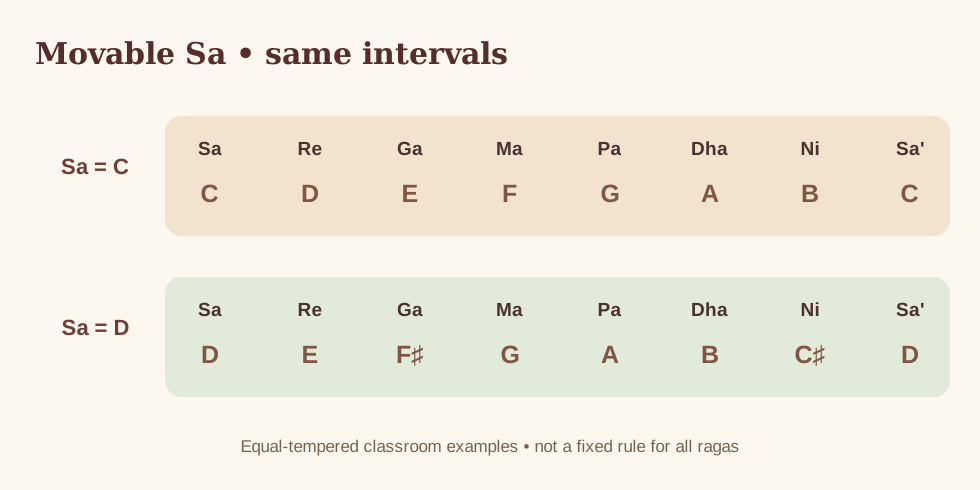
This is why a note name alone cannot be a universal definition of a swara. In the C example, Re is D; in the D example, Re is E. The music is organised around the chosen Sa.
Sapta Swaras in Hindustani and Carnatic learning
Both traditions use the same seven Sanskrit name families, but terminology for altered swaras and common beginner exercises differ. Hindustani texts often use shuddha, komal and tivra; Carnatic materials use numbered swarasthanas such as R1 or G3.
All-shuddha practice
A beginner may practise Sa Re Ga Ma Pa Dha Ni Sa in a Bilawal-like setting. This is one pedagogical example, not the only valid approach.
Mayamalavagowla
Sarali Varisai is often introduced in Mayamalavagowla, S R1 G3 M1 P D1 N3 S. With Sa=C, an approximate keyboard pattern is C C♯ E F G G♯ B C.
Read your key
Marks for altered or upper/lower swaras can differ between printed methods. Follow your teacher's scheme rather than mixing conventions.
The NIOS Hindustani Music textbook and NIOS Carnatic Music lessons give formal teaching examples. Avoid assuming the Carnatic “Ri” in one lesson is necessarily the same position as shuddha Re in an all-shuddha Hindustani exercise.
What is a saptak? Mandra, madhya and taar
One saptak spans Sa to the next Sa. Students refer to lower mandra, middle madhya and upper taar registers. An octave doubles frequency: if C4 is 261.63 Hz in an equal-tempered example, C3 below is about 130.81 Hz, and C5 above is about 523.25 Hz.
A teacher may put dots below swaras for mandra and above for taar. Plain text sometimes does not display them reliably; our examples use .Ni for lower Ni, Ni for middle Ni, and Ni' for upper Ni. Read the notation key before singing.
How to sing the seven swaras: a beginner Sargam exercise
This exercise uses only shuddha notes for a simple Hindustani-style introduction. Carnatic students should follow the raga and swarasthanas assigned by their teacher. A warm, relaxed voice matters more than speed. If any note causes tension or pain, stop, lower the range and ask for guidance.
- Warm up gently. Breathe without forcing and hum an easy middle-range note. Do not try to reach upper Sa immediately.
- Find a comfortable Sa. Use a keyboard, harmonium, teacher or drone. Make sure there is room above and below without strain.
- Match Sa. Listen quietly, sing Sa on “aa” for a short comfortable breath, pause and listen again.
- Learn the ascent. Sing Sa Re Ga Ma Pa Dha Ni Sa' slowly, one swara at a time.
- Learn the descent. Sing Sa' Ni Dha Pa Ma Ga Re Sa, returning calmly to your home note.
- Try a simple alankar. Sing Sa Re Sa | Re Ga Re | Ga Ma Ga | Ma Pa Ma, then return to Sa.
- Review by ear. Is your last Sa steady against the drone? Focus on evenness, not volume or speed.
Sa Pa Sa' Pa Sa
Sa Re Ga Ma Pa Dha Ni Sa'
Sa' Ni Dha Pa Ma Ga Re Sa
Sa Re Sa | Re Ga Re | Ga Ma Ga
The apostrophe denotes upper register. Bars divide readable groups; they are not automatically beats in a tala.
Practise Sargam with the free tanpura player
Open Tanpura.online and choose a comfortable Sa and octave. For this basic exercise keep Pa selected; turn the volume down so you can sing over the drone. Choose the electronic or acoustic recording you find easiest to hear. Let it play quietly before starting your first Sa.
Let your ear settle; hum along gently.
Return often to your tonic without forcing the upper register.
Use your teacher or independent reference for Re, Ga and the other melody notes.
Come back to a steady Sa and listen again.
Our player is a drone, not a Sargam keyboard or microphone pitch grader. It cannot play each swara on demand or tell you whether you sang accurately. Moving Sa transposes recorded audio and can change natural plucking pace and tone. For more about the physical drone, see the instrument guide; for string tuning, see our tuning walkthrough.
Common beginner mistakes
- Sa is always C: no, every singer chooses a suitable reference.
- Seven names must mean seven keyboard keys: altered swaras create twelve familiar positions in elementary Hindustani theory.
- Komal means soft: it means a lower pitch position, not a quieter sound.
- Every school starts with Bilawal: teachers and traditions differ; Mayamalavagowla is a common Carnatic introduction.
- A tanpura plays the melody: it holds the drone; you sing the swara sequence.
Frequently asked questions
What are the seven Sapta Swaras?
Sa, Re/Ri, Ga, Ma, Pa, Dha/Da and Ni, with the Sanskrit names Shadja, Rishabha, Gandhara, Madhyama, Panchama, Dhaivata and Nishada.
Why twelve positions if there are seven swaras?
Seven is the count of basic names; the familiar Hindustani framework adds four komal and one tivra variant, giving twelve positions.
Is Sa always C?
No. Sa is the home note selected by the performer. It may be C, D, G or another comfortable pitch.
What is a saptak?
The range from a Sa to the Sa one octave higher, with the seven names inside it.
What is the difference between Shruti and Swara?
Swara is a named note, while Shruti has more than one pitch-related meaning. Read our Shruti explanation for the historical 22-Shruti framework and the practical reference-pitch meaning.
Can a tanpura play all seven notes?
No. A traditional tanpura supplies a drone, usually including Sa and Pa; the musician supplies melody notes.
Research sources and editorial scope
- NIOS Hindustani Music, Theory Book 1, Chapter 1 — swara categories, notation and octaves.
- NIOS Carnatic Music, Book 1, Chapter 4 — introductory Sarali Varisai and Mayamalavagowla.
- Artium Academy · Swar Notation — current beginner notation reference.
- SwarGanga · Swar (Note) — movable tonic and swara meaning.
- Raag Hindustani · Notes in an Octave — movable-Sa teaching examples; terminology evaluated critically.
- Hero photograph: Sajal Kayan · CC BY 2.0, via Wikimedia Commons. The photo may be responsively cropped in the site layout; view original.
The tables use equal-tempered keyboards only for illustration. They do not claim a single exact intonation for every raga, and this article has not been independently certified by a teacher.