

How do you find your Sa for singing?
Choose a comfortable note, hum it against a tanpura drone, and test whether you can reach the lower and higher notes in your actual lesson without strain. Compare a nearby pitch if needed. Your Sa (also called your shruti in some Carnatic teaching) is a chosen tonic—not a fixed piano key that every singer must use.
What does choosing Sa actually mean?
In Indian classical music, Sa is your musical home note. Re, Ga, Ma, Pa, Dha and Ni are heard relative to that tonic. Two people can sing the same sargam phrase with different actual pitches as Sa. A singer whose Sa is C will use different keyboard keys from a singer whose Sa is D, yet both can correctly sing Sa Re Ga Ma.
In everyday Carnatic learning, shruti often refers to the chosen base pitch. This is different from the historical twenty-two-shruti theory. You can read our Shruti explanation or explore the note names in our Sapta Swaras lesson without confusing those separate topics.
The key idea is comfort across a phrase, not one impressive note. A single Sa may feel easy for a few seconds while lower notes sound weak or high phrases become forced. Choosing a suitable pitch means considering the practical range of the music you are learning.
The Esplanade lesson on Hindustani and Carnatic music recommends comparing lower and higher Pa with a candidate Sa in teaching. The Karnatik beginner's guide advises finding a comfortable pitch with a teacher and avoiding vocal strain. These are useful teaching approaches, not a compulsory range requirement for everyone on their first day.
Find your Sa in five practical steps
Start with a familiar keyboard, harmonium, teacher's reference or the recorded drone on our website. Sing at a conversational level. Do not push your voice to its highest or lowest possible note just to measure a bigger range.
- Begin with gentle humming. Hum an easy note around the middle of your comfortable speaking-to-singing range. Breathe normally and let the sound settle; do not use a loud shout or whisper as your test.
- Choose a candidate Sa. Match the hum to a reliable note source, choosing the correct octave. The candidate might be C3, D3 or something else; the examples do not prescribe a pitch for your voice.
- Listen and return. Start the tanpura at that Sa, sing it gently for one comfortable breath, stop and listen, then return to Sa. Does the note feel relaxed and fairly repeatable?
- Check a short low-to-high phrase. Sing Sa–Pa–upper Sa if comfortable. If your assigned lessons reach lower Pa or higher Pa, test those gradually with your teacher's guidance. If any sound causes pain or obvious strain, stop.
- Compare neighbouring pitches. Move the selected Sa up or down one semitone and repeat the same small phrase. Notice which setting supports the high notes and keeps the lower notes clear. Record the note and octave you choose.
Do not change the tonic after every uncertain attempt. Many beginners need time simply to match an external pitch. That is a listening skill—not proof that Sa itself is wrong. Try the best candidate over several short sessions, then review it with a teacher.
Check your low and high notes without forcing them
The usable singing range matters more than the most extreme sounds you can produce. The next checkpoints can help you choose a pitch that works for your own exercises. They are not a grading test, and a beginner does not have to reach all of them immediately.
| Note | Try | Listen for |
|---|---|---|
| Middle Sa | Hum softly, pause, then return | Steady, relaxed centre |
| Middle Pa | Move up a fifth if comfortable | Clear tone without pressure |
| Upper Sa | Reach the next octave only when ready | No shouting or tight neck |
| Lower Pa | Explore if required by your lessons | A usable note rather than a forced croak |
| Upper Pa | Advanced/teacher-guided check | Comfortable reach, not a demand to extend range |
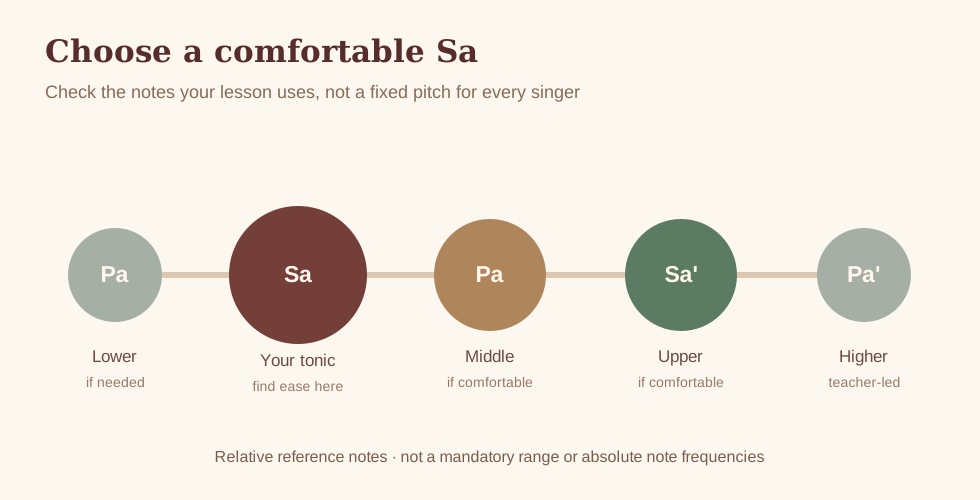
Some advanced repertoire extends across multiple registers. Beginners can practise a smaller range first. The Raag Hindustani learning tools explain choosing a tonic that puts the main practising octave within a comfortable part of the voice. The goal is musical consistency and listening, not winning a high-note contest.
Worked examples: moving Sa by one note
Suppose you start with Sa = C3. In the conventional twelve-tone equal-tempered system with A4 = 440 Hz, that reference is approximately 130.81 Hz. If your exercise has uncomfortable upper notes, you might try Sa at B2 (123.47 Hz), while checking that your lower notes remain usable. If the lower notes feel too weak instead, try C♯3 (138.59 Hz) and compare.
A second singer may find D3 (146.83 Hz) more comfortable. The same swara exercise can be transposed to that tonic. Neither singer is singing the “wrong Sa” merely because their reference differs. These values are keyboard-style illustrations; Indian raga intonation is not defined by one universal set of equal-tempered frequencies.
| Candidate Sa | Approx. frequency | What to check |
|---|---|---|
| B2 | 123.47 Hz | Do lower notes stay clear? |
| C3 | 130.81 Hz | Is the working range balanced? |
| C♯3 | 138.59 Hz | Does the upper phrase still feel easy? |
| D3 | 146.83 Hz | Does your comfortable octave fit? |
A Western pitch letter needs an octave label when frequencies matter. Some keyboards and apps use different octave numbering, so compare sounds or frequency values when the number seems inconsistent. In a Carnatic lesson your instructor may instead use kattai names; ask which note and octave their label represents.
Use Tanpura.online to compare candidate Sa settings
Once you choose a comfortable note, check our tanpura size and type guide before selecting a physical instrument.
Our free online tanpura offers a twelve-note selector with familiar Western note labels and harmonium-style Safed/Kali names, octave choices, Pa/Ma first-string selection, volume, and two genuine recorded sound sources: acoustic tanpura and electronic Raagini tanpura-machine recordings.
- Open the player and lower the volume. Its initial setting is C3 (Safed 1), Pa and the electronic recording. That is a site default, not a recommended key for every singer.
- Pick your candidate note and octave. Try humming Sa quietly while the drone plays. Focus on a steady, easy middle note.
- Try a small phrase. Return from Pa or a nearby swara to your tonic. Use your teacher or a separate note reference if you are unsure which melody pitch to sing.
- Move one semitone. Keep the sound source and volume similar, choose a neighbouring Sa and repeat. Compare comfort across the phrase, not just which drone sounds brighter.
- Note your choice. Write down the tonic and octave; the player also offers a setup-link feature to reuse a setting. Try it through several practice sessions.
For tuning the strings of an actual physical instrument to the pitch you chose, see our tanpura tuning guide. Do not force the tension of a real tanpura merely to match an arbitrary software octave.

How to tell whether Sa may be too high or too low
Possibly too high: the upper part of a normal phrase becomes a shout, your neck tightens or you start pushing the breath. Try a slightly lower candidate only if the bottom of your working range remains comfortable.
Possibly too low: the lower notes of your practice exercise become breathy, indistinct or croaky, even when the middle and upper parts feel easy. Compare a slightly higher Sa; do not force the low notes to sound louder.
Possibly a good fit: you can return to Sa, sing the necessary parts of your practice phrase and remain relaxed at both ends. It may still take regular lessons to improve note accuracy; a comfortable Sa does not guarantee perfect pitch matching.
Published descriptions sometimes group common singer reference pitches by gender or vocal tradition, including a research discussion of Carnatic singers' base pitches. These describe observed tendencies—not rules for individuals. Your actual useful range and repertoire are more relevant than demographic averages.
A five-minute routine for choosing a useful Sa
Hum gently and choose an initial candidate on the tanpura player.
Sing Sa, pause, listen, then return without forcing the voice.
Try middle Sa and Pa, or an appropriate teacher-approved phrase. Skip any uncomfortable extremes.
Change Sa by a semitone and repeat. Notice whether the upper and lower parts remain clear.
Write down the note, octave, what felt easy, and what needs a teacher's advice.
Practise with a stable Sa rather than endlessly switching pitches. If you have recurrent pain, persistent hoarseness or unusual strain, stop and seek suitable professional advice. This article does not assess vocal health or replace an experienced music teacher.
Common mistakes when choosing your singing scale
- Assuming everyone has the same Sa. The tonic moves to suit the performer and music. Do not automatically copy your teacher's absolute pitch.
- Testing only the easiest middle note. A workable reference should also support the low and high notes you are currently learning.
- Choosing the very lowest sound you can produce. That can leave the higher exercise inaccessible. Use your comfortable working range, not just an extreme.
- Taking a generic gender chart as an instruction. Typical ranges can offer context but cannot choose your Sa for you.
- Expecting a tanpura website to analyse your singing. A drone provides a reference, not live vocal grading.
- Changing Sa after every imperfect note. Pitch matching improves with careful listening and practice; not every wavering swara means the tonic is wrong.
Frequently asked questions
How do I know which Sa is right for my voice?
Choose an easy reference and test the lower and upper notes required in your lessons. Prefer a candidate that makes the entire short phrase comfortable, not only the first note.
Is Sa always C?
No. Sa is a movable tonic; any appropriate note can be Sa. C is only one keyboard reference.
Does my Sa have to match my teacher's?
Not always. Your teacher can help transpose an exercise to a suitable pitch for your voice.
Can my Sa change as I learn?
Yes. Different repertoire, technique and comfort may lead you to adjust the reference. It is useful to keep a stable setting during routine practice.
What is the difference between Sa and Shruti?
Sa is the tonic. In everyday Carnatic lessons “shruti” often means the chosen reference pitch; the word also has a distinct historical theoretical meaning.
Can I choose Sa from my lowest note alone?
A comfortable low note can suggest a candidate, but it is not enough on its own. You also need to check your useful upper range.
Does Tanpura.online detect my Sa automatically?
No. It offers recorded tanpura drones with manually selectable note and octave, without microphone analysis or automatic pitch assessment.
Sources and genuine photograph credits
The sequence above is an original beginner-friendly synthesis of published teaching principles. It is not an automatic pitch-finder, a vocal examination or a copy of another site's interactive exercises.
- Esplanade — Introduction to Carnatic and Hindustani Music — check lower and higher reference notes when evaluating a candidate sruti.
- Karnatik — Beginner's Lessons — choose a comfortable tonic with teacher guidance and avoid strain.
- Raag Hindustani — Learning Tools — the singer's working range and choice of tonic.
- Center for World Music — The Voice in South Indian Classical Music — movable Sa and use of a drone.
- Carnatic singer study — observations about reference pitch; not a universal key recommendation.
- Real photo of a Carnatic singer: Pradeepkrl · CC BY-SA 4.0 · Wikimedia Commons. Photo resized or responsively cropped; view original.
- Real photograph of two tanpuras: Martin Spaink · CC BY-SA 3.0 · Wikimedia Commons. Photo resized or responsively cropped; view original.
Reference frequencies use twelve-tone equal temperament with A4 = 440 Hz, purely as examples. Musician practices and teaching approaches differ. No AI-generated photographs are included.